









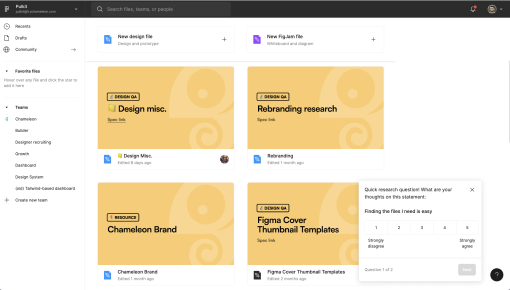
Figma's Microsurvey
Figma’s microsurvey is a quick, thoughtful touch to gather feedback on file navigation. The first question...



Existing customer? Sign in
Measure how essential your product is to users by asking how disappointed they would be if they could no longer use it, helping you understand if your product truly meets their needs. Identify whether you have achieved product/market fit based on how many users say they would be "very disappointed" to lose access.
Product/market fit is the holy grail of SaaS success—the moment when your product resonates so deeply with users that they can't imagine living without it. But how do you know when you've achieved it? The answer lies in a deceptively simple survey question that has become the gold standard for measuring product/market fit.
The "disappointment survey," pioneered by growth expert Sean Ellis, cuts through vanity metrics to reveal the truth about your product's market position. This product market fit survey template helps product teams quickly assess whether they've built something users truly value or if they're still searching for that elusive fit.
With Chameleon's Survey feature, deploying this critical measurement becomes effortless. You can target specific user segments, trigger surveys at optimal moments, and gather the insights needed to guide your product strategy—all without disrupting the user experience.
A product/market fit survey is a research tool designed to measure how essential your product has become to your users' workflows and lives. The concept was developed by Sean Ellis, who recognized that traditional satisfaction surveys often failed to predict actual user retention and growth potential.
The core of this survey revolves around one crucial question: "How disappointed would you be if you could no longer use [product name]?" Users choose from three response options:
- Very disappointed - Somewhat disappointed - Not disappointed
The magic happens in the analysis. Ellis discovered that companies achieving sustainable growth typically see at least 40% of respondents select "very disappointed." This benchmark has become the industry standard for determining whether you've achieved product/market fit.
This single question reveals more than complex satisfaction surveys because it measures dependency rather than mere satisfaction. A user might be satisfied with your product but easily switch to a competitor. However, if they'd be "very disappointed" to lose access, you've created genuine value that's difficult to replace.
Chameleon's Survey feature makes deploying these critical measurements seamless. Unlike generic survey tools, Chameleon allows you to target specific user segments based on behavior, demographics, or engagement patterns, ensuring you're gathering feedback from the users who matter most to your business.
Creating an effective product market fit survey requires careful planning and execution. Here's your step-by-step guide to implementing this template:
1. Survey Setup Configure the disappointment question with clear, unambiguous response options. Keep the wording simple and direct. In Chameleon's Survey builder, create a single-question survey with three radio button options. Avoid adding unnecessary complexity that might confuse respondents or dilute your results.
2. Targeting Your Audience Define your user segment carefully. Focus on active users who have experienced your product's core value proposition. Surveying brand-new users or inactive accounts will skew your results. Chameleon's audience targeting capabilities let you segment by user behavior, subscription tier, feature usage, or time since activation.
3. Timing Optimization Trigger your survey after users have had sufficient time to experience your product's value. This might be after completing key actions, reaching usage milestones, or spending a specific amount of time in your application. Chameleon's behavioral triggers ensure your survey appears at the optimal moment in the user journey.
4. Follow-up Strategy Prepare different follow-up questions based on responses. Users who select "very disappointed" might be asked what they value most about your product. Those who choose "not disappointed" should be asked what would make the product more valuable or what alternatives they might use.
5. Analysis Framework Calculate your PMF score by dividing "very disappointed" responses by total responses. Track this metric over time and segment by user characteristics to identify patterns. Chameleon's integration capabilities allow you to push survey data to your analytics tools for deeper analysis.
The key advantage of using Chameleon for product market fit surveys is the platform's ability to present surveys naturally within your product experience, maintaining high response rates while preserving user satisfaction.
Maximizing the value of your product market fit survey requires following proven best practices that ensure accurate, actionable results.
Timing Your Surveys Strategically Survey users after they've experienced your product's core value, not during their first session. For most SaaS products, this means waiting until users have completed onboarding and engaged with key features. Premature surveying leads to uninformed responses that don't reflect true product dependency.
Managing Survey Frequency Avoid survey fatigue by spacing measurements appropriately. Quarterly or bi-annual surveys typically provide sufficient data without overwhelming users. However, you might survey more frequently during periods of significant product changes or when actively working to improve PMF scores.
Segmentation for Deeper Insights Analyze results by user type, acquisition channel, subscription tier, or feature usage patterns. Different user segments may have varying relationships with your product. Power users might show higher PMF scores than casual users, revealing opportunities for better onboarding or feature discovery.
Crafting Effective Follow-up Questions Design different follow-up paths based on initial responses. Ask "very disappointed" users what specific features or benefits they value most. Query "not disappointed" users about what would increase your product's value or what alternatives they might consider. This additional context transforms raw PMF scores into actionable product insights.
Connecting Results to Product Strategy Use PMF survey results to guide roadmap decisions and resource allocation. Low scores indicate fundamental product-market alignment issues that require strategic pivots. High scores suggest you're ready to focus on growth and optimization rather than core product development.
Chameleon's non-intrusive survey presentation maintains user experience quality while gathering critical feedback. The platform's advanced targeting ensures you reach the right users at precisely the right moment, while integration capabilities enable comprehensive user journey mapping that connects survey responses to actual behavior patterns.
Q: How often should you measure product/market fit? Most successful SaaS companies measure PMF quarterly or bi-annually. This frequency provides regular insights without creating survey fatigue. However, measure more frequently during major product launches or when actively working to improve your PMF score.
Q: What's a good sample size for PMF surveys? Aim for at least 100 responses to ensure statistical significance, though 200-500 responses provide more reliable insights. The key is ensuring your sample represents your broader user base across different segments and usage patterns.
Q: Should you survey all users or specific segments? Focus on active users who have experienced your product's core value. Surveying inactive users or those who haven't completed onboarding will dilute your results. Use Chameleon's targeting capabilities to reach users who've demonstrated meaningful engagement.
Q: How do you improve PMF scores over time? Analyze feedback from "not disappointed" users to identify missing features or value propositions. Focus on enhancing the aspects that "very disappointed" users value most. Consider whether you're targeting the right market segment or if your positioning needs adjustment.
Q: What other metrics complement PMF surveys? Combine PMF scores with retention rates, Net Promoter Score (NPS), feature adoption metrics, and customer lifetime value. These metrics together provide a comprehensive view of product-market alignment and user satisfaction.
Consider adding optional follow-up questions to deepen your insights. Demographic questions help segment responses, while feature-specific satisfaction questions reveal which product areas drive the strongest user attachment. You might also include referral likelihood questions to understand the connection between PMF and organic growth potential.
The product market fit survey template provides the foundation for understanding your market position, but the real value comes from consistent measurement, thoughtful analysis, and strategic action based on your findings. With Chameleon's Survey capabilities, you can deploy this critical measurement tool seamlessly while maintaining the user experience that drives the very satisfaction you're measuring.


Start a free trial or talk to our team.