






🤔 Challenge: Optro's engineers started shipping faster and product managers asked for more announcements, while one person in product operations was still building every in-app message.
💡 Solution: Copilot turns each request into a draft plan and tightens the copy, element targeting holds up across heavily configured customer setups, and an Announcement Tour carried the rebrand from AuditBoard.
🏆 Results: The rebrand announcement reached about 13% click-through, roughly four times Optro's usual 3–5%, and users are more positive about in-app messaging than they were.
Plan: Growth
Main use case: Feature Adoption
Built with: Copilot · Announcement Tours · Embeddables · Microsurveys · Templates · element targeting · Amplitude integration
Challenge
Optro builds governance, risk, and compliance software, and its customers configure the platform heavily enough that the same page can look different from one client to the next. When Optro changed its platform navigation, Pendo, the analytics and adoption tool they were using at the time, couldn't keep up.
"Pendo as a tool, I would say, is more of a jack of all trades, master of none," says Adnan Akbari, Senior Product Operations Analyst, who runs in-app guidance at Optro. "It does a lot of things, but it doesn't do any one thing really well."
Switching tools was also an opportunity to change how in-apps got built and published. "With Pendo, we kind of just didn't have any kind of process," Adnan says. "Whatever people wanted published, you'd publish, and we weren't very deliberate about targeting."
Today, Optro keeps in-app messaging on a short leash. Any team that wants to reach users submits a request through a Slack form, and product operations decides whether it ships and who sees it. Under-messaging is the deliberate trade-off that buys them attention. When something does appear, users read it rather than reach for the dismiss button.
Then Optro's engineers got faster. Releases picked up, product managers started asking for more announcements, and Adnan was still the only person building it.
Solution
When the queue gets longer than his week, Adnan opens Copilot. The intake process hasn't changed, and his team still decides what ships. Copilot makes it possible for one person to keep up with everything that's approved.
Requirements in, plan out
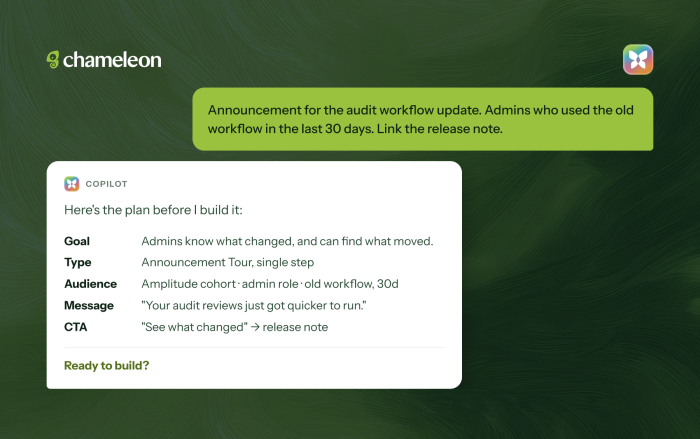
Adnan hands the requirements to Copilot, gets back a draft plan, then adjusts the URLs and segmentation. With the setup handled, his time goes to the judgment calls: whether the targeting is right, and whether the message is doing the work.
That counts most in the weeks when several requests land together. "There are times when we may get a ton of unique requests within a week. And then we just use Copilot to get those out quicker than building them out one by one. It has reduced a lot of manual effort on our side and it does a very good job of enhancing copy."
💡 Chameleon tip: Share the plan Copilot drafts with whoever raised the request, so they can review or adjust it in the same chat. The context stays in one place, and you get sign-off before anything gets built.
A second pair of eyes on the copy
Anyone at Optro can raise a request, from product managers to the events team. Writing in-app copy is a skill in itself, and most people only submit a request a few times a year.
"A lot of times when we get requests, the people submitting the copy, they might not be technical writers, or they might not know the best language to use," Adnan says. "If we know something's too wordy, we'll run it through Copilot, have it come up with a better version."
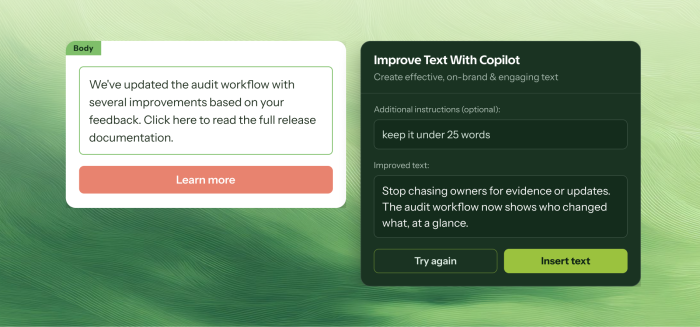
Every message that ships clears the same bar, whoever drafted the first version.
Targeting that survives a UI that keeps moving
Because customers configure the platform themselves, a button can sit in one place for one client and somewhere else entirely for the next. Targeting by position would break constantly.
"Our platform views can differ from one client to another client, and we're not always sure the elements on the page will be consistent," Adnan says. "The way Chameleon allows us to target elements has allowed us to be pretty flexible, accounting for the different configurations from site to site."
Custom CSS and JavaScript cover the rest. Day-to-day, targeting runs through Amplitude cohorts, so Optro can segment on what users do. That flexibility is the difference between guidance that holds and guidance that needs to be re-pointed after every release.
The one time they went wide
By now, Optro has a routine that works. Most requests go out as a Banner, the least disruptive option for users. But when Optro had to announce its rebrand from AuditBoard, a Banner wasn't going to cut it.
Nearly every user needed to see the new name before they mistook Optro for something else, and email couldn't get there fast enough.
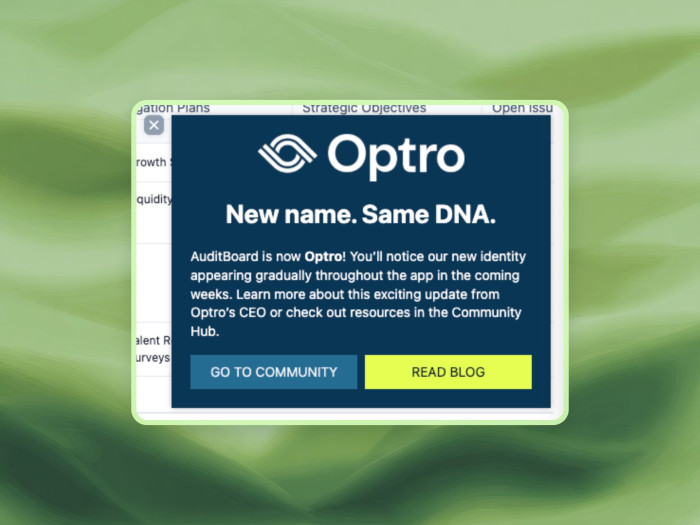
So Optro reached for an Announcement Tour. "We wanted users, as soon as they log into the application, to be aware that they may see this name pop up," Adnan says. Triggering at session start meant users met the new name before they had started on anything.

We're far more likely to drive awareness where users are doing their work, in our application. As soon as they log in, they'll become aware of it. Versus email, where they may not check it, they may have missed it.
It linked straight to the CEO's blog post explaining the change.
💡 Chameleon tip: Smart Delay controls when a message appears within a visit, so it can wait for someone to settle instead of firing the instant a page loads. Use it when the message can afford to wait a beat, and skip it when everyone needs to see the thing the moment they log in.
Results and next steps
The rebrand announcement got roughly four times the click-through Optro's in-app CTAs normally see. Against an average of 3–5%, this one reached about 13%.
- Drove traffic to the CEO's blog post and to a thread on Optro's Community page. Adnan called the Tour one of the primary drivers of awareness for the name change
- Users are less frustrated by in-app messaging than they were, tracked in Enterpret. Adnan: "I have seen more positivity towards in-app messaging."
- Users learn new features in place instead of leaving to find help
- Also drives registrations for CRX, Optro's annual user conference, and the webinars they run three to four times a month
If Copilot went away, we'd have to go back to exporting analytics into a Google Sheet and manipulating data… plus building things out manually. And we'd need one of our tech writers to review all the copy.
Optro's engineers aren't slowing down, and the requests following them through the Slack form aren't either. Product managers who used to leave feature awareness to release notes are now asking for in-app messaging by name. It still all runs through Adnan.
Chameleon provides the ideal medium to socialize a critical announcement or quick tips. Copilot fits very well into our stack and has allowed us to drive forward our AI-first adoption mindset.
👉 Want to keep up with every release without growing the team? Talk to us.