






🤔 Challenge: Email stopped reaching bexio's customers, so four teams moved to in-app, with no shared view of who was reaching whom, and customers who don't want to be interrupted.
💡 Solution: One shared queue with clear rules on what ships when, messages targeted to the right customers, a different format for each type of message, and limits on how often anyone gets asked.
🏆 Results: 2.5x more customers switched on a new feature the day after a single in-app survey went live, four teams share one channel without clashing, and a tour customers found very helpful guided them through a new navigation.
Plan: Growth
Main use case: Feature Adoption
Built with: Embeddables · Announcement Tours · Microsurveys · Rate Limits · Segments · Themes · Salesforce integration
Challenge
bexio builds the accounting and business software that Swiss SMEs run their back office on. Reaching those users used to mean email. "People get too many emails. Mails don't reach customers, at least that's what we find," says Ruben, Head of User Experience.
So the teams with something to tell users landed on the same channel: in-app. Chameleon was already there, so it became the one they all leaned on harder. Product and Marketing had releases and promotions to push. The customer education team had training resources, and the tech team filed the planned outages.
Four teams on one channel, with no shared view of who was reaching whom. And bexio's customers had already been clear about what they didn't want: to be interrupted mid-session. bexio needed a way to let every team engage users without bombarding them.
Solution
One shared queue, owned by Micaela on the product team, with rules on what shows where and how it gets displayed with Chameleon.
One queue, one timeline
Every request becomes a Jira ticket first, so Micaela can see the whole week in one place.
"The most important thing there is that we have an overview of the timeline, because product is using Chameleon, marketing, and also education," she says. If nothing else is already booked for that audience that week, it ships as requested. If the week is crowded, it waits its turn. "Normally, we only have a look at the timeline, and we know if we can activate the experience as requested."
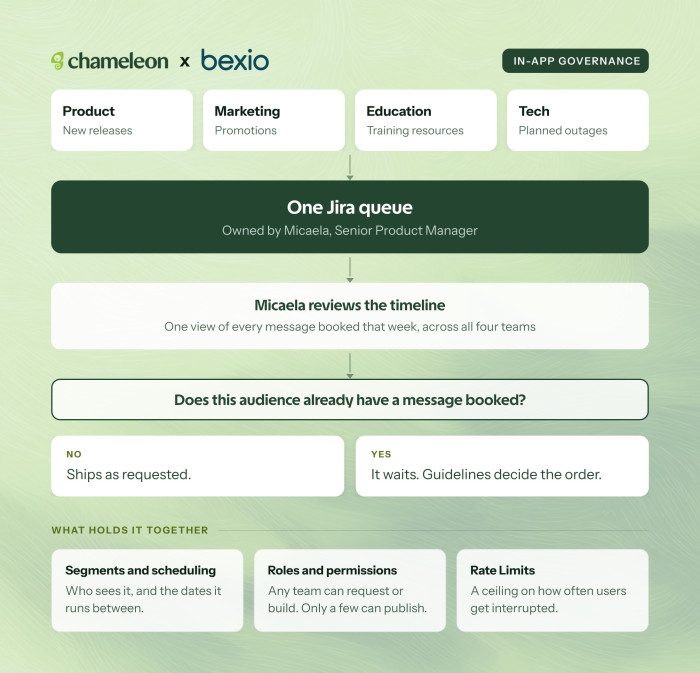
Segments carry the lists bexio builds in Salesforce, so each message lands on one defined group. That's what lets all four teams share a single week without the same user hearing from all four.
Guidelines for when the timeline's busy
Competing requests started arriving so often that a timeline check alone wasn't enough. Ruben's team built a concept for it: a prioritization model that decides which message wins when two land in the same week, published so every team can read it.
This way, anyone knows before sending a request whether a message can go out and when. Roles and permissions in Chameleon open up building to more teams, without widening who can publish. So bexio can keep saying yes without the work landing on Micaela.
Matching the format to the message
bexio uses almost every in-app pattern Chameleon offers, and each has a job. Embeddable Cards carry promotional content. Banners handle what a user needs to see regardless of what they're in the middle of, such as API downtime or a planned outage. Microsurveys collect feedback, and the team keeps Announcement Tours for the handful of messages a user would be annoyed to have missed.
💡 Chameleon tip: Create different styles per message type, so a promotion and a system notice never look alike. Users learn which is which before they read a word, and you set it once instead of styling every experience.
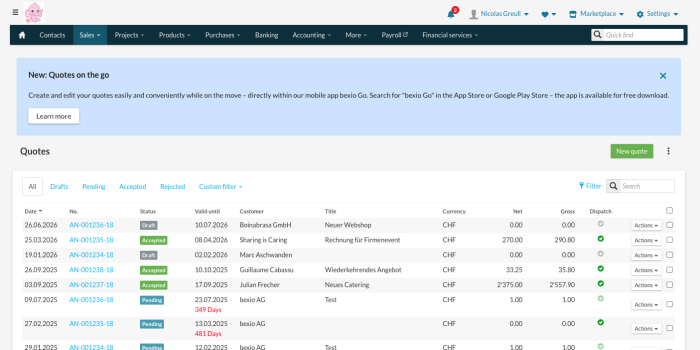
Want a closer look? We break down this banner in our Inspiration gallery: bexio's New Feature Embedded Banner.
Chameleon gives them a distinct format for every level of urgency, so nothing has to shout to get noticed by the right users.
A cap set by statistics
CSAT carries weight at bexio, and it's built into the product teams' processes and targets. Their survey has run without a break for more than three years, and they're careful about how long it stays open.
"We have a threshold of 1,000 answers, as we already know that it's statistically irrelevant if we get more," Ruben says.
That turns a judgment call into a setting: past this number, more answers change nothing and still cost a user's attention. Chameleon can automatically unpublish a Microsurvey once it reaches a set number of responses. And Rate Limits separately prevent any one user from being asked too often, without somebody watching a counter.
Results and next steps
bexio now reaches people email no longer does, with the Marketing team requesting in-apps more often than any other team. "We ramped up the usage of Chameleon considerably in the last years," says Ruben.
bexio's Document Archive, launched in March, only works once a customer switches it on. When bexio ran a Microsurvey asking non-users why they hadn't, some said they didn't know it was in their plan, and the survey itself fixed that. Activations went from an average of 10 a day to 25 the day after the survey went live.
- NPS runs alongside CSAT, with both feeding the same reporting, and product team KPIs are now set against them.
- CSAT responses cap at 1,000 by design. Comments and sentiment go to Tableau and Caplena for deeper analysis.
- Four teams publish through one queue, with guidelines that settle the order when two land in the same week.
Chameleon's Governance makes their selectivity practical. Who sees each message, who can build, who can publish, and how often anyone gets asked, all help bexio hold the line on what reaches users.
We have to be a bit careful [with in-app messages], because we hear from customers that they don't want to be interrupted when they are in the product. Every time we receive requests for new experiences, we evaluate if this makes sense, if this is needed, and ensure we have the right target audience.
That care is now turning into design work, as Ruben's UX team builds a clearer in-app system with distinct Themes, so a new-feature message and a promotion are recognizable at a glance. The biggest test so far came at the start of September, when bexio moved its primary navigation from the top of the screen to the left-hand side. A Chameleon tour walked customers through it. Micaela says it was "very helpful to our customers," and it doubled as a reminder of what lives in each module.
👉 Want to give every team a voice in-app without overwhelming your users? Talk to us.